Saturday, November 7, 2009

Your Last Carbon Footprint

You recycle, you use canvas bags at the grocery store, you conserve water, you don’t put chemicals on your yard, and you drive a hybrid vehicle. Would you like to reduce the carbon footprint of your life’s final ritual as well? Tips on how to do exactly that are in a 4-minute CBS feature story on home funerals and green burials in the Philadelphia area. CBS interviewed members of Natural Undertaking, a Pennsylvania resource center for home funeral care. The 20-second discussion among the news anchors at the end of the story is priceless.

Saturday, October 31, 2009

The Next Step

Last year at the Midwest Independent Publishers Association Book Awards ceremony, Living Consciously, Dying Gracefully won first place in the Health category. After accepting our award in front of 300 publishers, booksellers, and authors and getting gold stickers for our books, Nancy and I were given the envelope of scoring sheets and comments from the judges. Our mouths dropped open when we read, "This book deserves a mainstream publisher and a national audience."

We hadn't considered going mainstream, but the judge's comment was a catalyst. We didn't do anything for a while, but then our friend Mary Treacy O'Keefe, author of Thin Places (also published by Beaver's Pond Press), started nudging us: Find an agent! You need to get to a big publisher! Find an agent! Call Larry Dossey and ask him who his agent is!

Eventually we contacted Larry Dossey, M.D., who had already written a beautiful blurb for our back cover, and he recommended a literary agent in northern California --Barbara Deal, owner of Literary Associates. Although she wasn't taking on any new projects, once she read Living Consciously, Dying Gracefully, she agreed to take us on.

We've been waiting out the economic crisis, but now that publishers are again buying manuscripts, Barbara thinks the time is right. So we wrote a book proposal for her to present to publishing houses. By the time we finished this 30-page description of our book, the market, the competition, and our passion for sharing Diane's story, even WE were impressed!

Last week, ten packets went out to ten publishers. If one of them likes the book, there could be a revised, expanded edition published by this time next year. We're keeping our fingers crossed. We hope that Diane's inspiring story can take the next step in reaching a much wider audience!

Monday, October 26, 2009

Lessons from a Hospital Chaplain

The current issue of Spirituality & Health: The Soul/Body Connection features an article entitled “What is a Good Death: A Hospital Chaplain Reflects on the Lessons from Her Patients.” One thing that attracted Karen Rushen to the spiritual care of the sick and dying was wanting “to know why some people appeared to have a ‘better death’ than others, passing from this life with less fear, pain, and resistance than other people.” She also wanted to look at her own “worst nightmares about sickness, pain, and end of life . . . .”

Rushen shares several experiences from her years with dying patients, from newborns to the elderly. My favorite story is of an elderly woman dying of cancer. Her husband sat by her hospital bed, “sobbing pitifully for days on end. Finally he fell asleep from exhaustion, and that’s when his wife passed away. Yet when he woke up, he was calm upon finding out that his wife had died, telling the staff that he had just had a very powerful dream in which his wife assured him that she loved him, and that she was in a wonderful place, waiting for him to join her someday.”

Rushen ends her reflections by observing that her job has taught her that “each day is precious, that health is not to be taken for granted, and that the most horrendous suffering can contain gifts and life lessons.” She also found that by facing her own fears squarely and by daring to ask herself and others some of “life’s most daunting questions,” she “experienced a profound clarity” around her own life’s purpose.

We don’t have to become a hospital chaplain or a hospice volunteer to learn these lessons. We can learn from any of the many wonderful books available on what to expect and how best to prepare for our own death or that of a loved one, books such as Susan Dolan’s End of Life Advisor, the recently published Jane Brody’s Guide to the Great Beyond, David Kessler’s The Needs of the Dying, and Elisabeth Kubler Ross’ classic On Death and Dying. This 1969 publication started the whole cultural shift toward dealing with death more openly. My copy (cost: $1.95) may have started me on a path that forty years later, led to becoming a home funeral activist.

We can also study contemporary spiritual teachers such as Eckhart Tolle, Byron Katie, Stephen Levine, and the Dali Lama, or go back to one of my all time favorite books, the 2nd century Roman classic, Marcus Aurelius’ Meditations.

We can watch movies that neither avoid nor romanticize death, films such as . . . oh, that’s a topic for another day. Meanwhile, carpe diem!

Nancy

Tuesday, October 20, 2009

Nancy in a Pulpit

One of the last places I expected to find myself was behind a raised pulpit, looking out over a congregation. I had been sitting in the sanctuary during the prayers and hymns. Now I stood for my sermon. Yes, my sermon.

I left the Catholic church when I was 21 and haven’t attended any denomination’s services except for an occasional wedding or funeral. I have something like an allergic reaponsevto church services. Had I actually agreed to speak at Birmingham Unitarian Church in Michigan?

Thankfully, sitting behind me, waiting to take her turn in the pulpit, was our friend and church member Susie Symons. Susie, featured in Living Consciously, Dying Gracefully, had made the arrangements, and would deliver her half of the sermon next.

The week before, at Hospice Volunteer Services of Vermont. I felt comfortable, articulate, even inspired. Afterwards, as we gathered up the few books we didn’t sell, I told Becky, “This was so enjoyable we really ought to give more presentations.”

But in front of the Unitarians my inspiration vanished. I felt shaken in a way I don’t normally before an audience. I opened my mouth and out came a croak. I cleared my throat, coughed, and finally managed a hoarse sentence. I plunged forward, gaining confidence. But three minutes into my remarks, I remembered that this was NOT the moment for my sermon. I was supposed to have read a poem first. Only after Susie had read a second poem, was my sermon to begin.

At my chagrined glance, Susie waved for me to continue. When I finished, she stepped to the pulpit and shared both her poem and the story of Diane’s impact on her. Susie, who had confided how nerve-wracking public speaking was for her, gave the most eloquent, beautiful sermon.

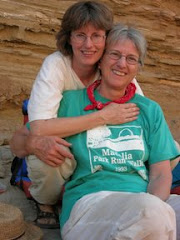
In the social hall after the service, church members were warm, gracious, and generous in the personal experiences they shared with Becky and me and in the number of our books they bought. Then Susie and her husband John Glick (a world-famous potter who made ceramic containers for Diane's ashes) took us home for a fabulous Italian lunch, never once mentioning my rattled performance. John took the above photo of Becky, Susie, and me in their back yard. True friends, pictured here.

Nancy

Wednesday, September 23, 2009

Our Joy of Giving

Yesterday, Becky and I gave 200 copies of Living Consciously, Dying Gracefully: A Journey with Cancer and Beyond to the Breast Cancer Awareness Association (BCAA) of Minnesota, enough so that each participant in the 8th annual Living with Breast Cancer conference can have a copy. (To register for this free October 3, 2009, conference at the Minneapolis Convention Center, click here.) Last year, we also donated copies to BCAA, and responses from recipients indicate that Bill and Diane Manahan’s story benefited them deeply.

Last month, I did something I’ve never done before. Since we were attending the week-long Manahan family reunion in Stowe, Vermont, Becky and I had offered to speak at Hospice Volunteer Services in nearby Middlebury. Bill and Diane’s daughter-in-law Kate Manahan (shown here with Diane), who recently completed hospice volunteer training in Maine, joined us. The hospice Executive Director anticipated 10-15 people would attend, but 30 volunteers and nurses showed up, some of them from hospices an hour away. These women and men were riveted by Diane’s story, crying and laughing right along with the three of us. At the end of our presentation, I said that anyone who bought a book could take a free copy for a hospice, hospital, library, or family of their choice. More books went out the door that afternoon than at any other presentation we’ve given, almost 50 copies.

For the second printing of Living Consciously, Dying Gracefully last year, we ordered 1000 extra copies so that we and Bill would have plenty to give away. We didn’t anticipate how rewarding those gifts would be nor how many cancer conferences, hospices, home-death groups, authors of books about death and dying, public libraries, and random acquaintances we’d connect with. We’ve donated more books than we ever imagined. Diane Manahan, a passionate community activist and philanthropist, would be delighted to see her story reaching so many people, supporting their ability to live more consciously and, when the time come, to die more gracefully.

A few months ago, Becky and I offered a complimentary copy to anyone whose personal end-of-life story is posted on http://www.nanbec.com/. So far, we have received only one story. We thought that the July 2009 New York Times front-page article on home funerals, which mentioned the book (and in the online edition, linked to our website), would spur submissions. Although Amazon.com ranking shot up —Living Consciously, Dying Gracefully became an overnight best-seller in the categories of holistic health, women’s issues, and death and grief—we didn’t receive a single story. The offer is still open. If you have a friend or family good-death story or know someone who does, please contact us: nanbec@nanbec.com.

Similarly, if you know a cancer center, hospice, grief group, or public library that could use a copy of Living Consciously, Dying Gracefully: A Journey with Cancer and Beyond, let us know the address, and we will donate a book in your name. Becky and I appreciate your support for our ongoing joy in sharing our sister-in law Diane Manahan's extraordinary and inspiring story!
Nancy

Monday, July 6, 2009

“Departures,” A Sublime Film

“Departures,” the winner of the 2009 Academy Award for Best Foreign Language Film, is an inspiring glimpse into Japan’s cultural heritage of caring for a body after death.

When a young Tokyo cellist loses his orchestra job, he and his wife move back to his hometown. He answers a classified ad entitled “Departures,” thinking it’s a travel agency only to discover that the job involves washing and casketing bodies. Daigo overcomes his initial revulsion and comes to love the reverential ceremonies, which are transformational for the families involved . . . and eventually for him and his wife.

“Departures” beautifully depicts an approach to death that could teach our culture much. It shows an option between conventional Western funeral practices and caring for our own at home. Although Daigo and his teacher wash and dress the body, they work quietly in the deceased person’s home with the family surrounding their loved one during the entire ritual. There is no embalming. Shocking, funny, and profoundly moving things happen during this process.

Anyone interested in threshold work, spiritual openings, personal transformations, or exquisite filmmaking will enjoy “Departures.” To see a trailer of the film, click http://www.youtube.com/watch?v=TaFRCLAYEF0.

Friday, May 29, 2009

Alison's Gift

When my sister-in-law had terminal-stage breast cancer, she and my brother read a book that changed their lives.

Alison’s Gift is the true story of a seven-year old killed by an air bag in a slow-speed collision. Her mother, Beth Knox, knew that when Alison was disconnected from life-support, she did not want a mortician to take charge. She wanted to bring Alison home, continue caring for her, share her grief, and give Alison’s brothers, grandparents, and friends time to say goodbye.

The hospital said it could not release Alison to her mother’s care. They eventually allowed an undertaker to transport the body home. As Beth learned later, the hospital was wrong; she had the legal right to take Alison home in the van in which she had driven her daughter to school each day.

For the next three days, Alison lay on her own bed. Friends and family members talked and sang to her, prayed and meditated, or just sat quietly, saying goodbye. Several of Alison’s Waldorf School classmates came, and even though some parents were apprehensive about letting them see a body, the children seemed quite comfortable. Spending time with their friend, far from being frightening or creepy, allowed them so experience death as a real and normal part of life.

As a result of this experience, Beth founded Crossings: Caring for Our Own at Death, a national non-profit educational organization. In workshops around the country, she teaches people how to care for a body at home, choose a final resting place, and understand the applicable laws in each state. (For a 3-minute Frontline You Tube story on home funerals featuring Beth Knox, click here.)

Just as the home birth movement has given families more control over birth, the home death movement, which Beth helped found, encourages families to take more control over the other big transition, returning death care to its rightful place as a last sacred family act of love.

My brother and sister-in-law, Bill and Diane Manahan, liked this idea. They ordered a home funeral kit from Crossings. In addition to instructions for after-death care, the kit contained essential oil of lavender for washing the body, a length of white silk cloth to drape over it, and candles. (Although this kit is no longer sold, a Handbook for Home Funeral Care is available for purchase or as a free pdf download at http://www.crossings.com/.)

My spouse Becky Bohan and I were with Diane when she died. I helped bathe and dress her body, hold a vigil, accompany her body to the crematorium, and bring her ashes back home for her life celebration three days later. Becky had a mystical experience at the moment of Diane's death and a joyful visit from Diane several hours later. These profound experiences led us to write Living Consciously, Dying Gracefully: A Journey with Cancer and Beyond, which has won six regional and national book awards and affected readers in ways similar to the impact Alison’s Gift had on our family.
Last month, when Becky and I were in Maryland, we spent an afternoon with Alison's mother. We liked Beth Knox immensely. She is an ideal home funeral educator -- warm, practical, visionary, and passionate about the environment. She told us about the remarkable deaths last year of her mother and her husband’s father, who died peacefully at home, and who requested and received a home funeral.

Following Beth’s lead, our local Minnesota Threshold Network offered a free public information session on home deaths and green, eco-friendly burials in Minneapolis this month. Resources, including Alison’s Gift, were available.

If readers of this blog know of someone who is interested in caring for their own at death, please extend an invitation to read this inspiring book, join the Crossings listserv, and learn from the experiences of Alison and her extraordinary mother.

Nancy