Monday, October 6, 2014

No Green Graves in the Heart of Minneapolis -- YET!


Entrance of Pioneers and Soldiers Memorial Cemetery
Minneapolis is not selling any empty plots. No chance of a green burial so close to home!

That's what I learned when my friend Ann Risch and I visited the oldest surviving burial ground in the city, a 15-minute bike ride from my home. Thousands of bodies have been removed from Pioneers and Soldiers Memorial Cemetery, leaving 7,000 empty plots owned by Minneapolis.

Pioneers and Soldiers opened in 1853 at Lake St. and Cedar Ave., the only Minnesota cemetery on the National Register of Historic Places.  Founded by an abolitionist, it was one of the few unsegregated cemeteries of its time, the final resting place of African American businessmen, fire fighters, and Civil War veterans. For 25 years, it was the only Minneapolis cemetery that accepted bodies of those who died without money or family to bury them. Plots cost $1 dollar.

See all the green space
As the city's population boomed and its boundaries expanded, most of the burial plots were sold. In the early 20th century, with dwindling income from grave sales, the owners sent letters to descendants of people buried on the 20-acre site asking them to remove their relatives. Thousands of bodies were soon disinterred.

A civic campaign to save the cemetery from being turned into a public playground or sold to business interests for development succeeded. In 1927, the Minneapolis City Council voted to purchase the cemetery and implement improvements, including the current limestone and iron fence.

Could Minneapolis start offering those 7,000 empty plots for natural burial? What would be the requirements? No embalming, biodegradable caskets or shrouds, no concrete grave liners, and environmentally-friendly grave markers. Being a pioneer for green burials right in the city would be fitting for a cemetery that pioneered a desegregated burial ground over a century ago!

Tattered flag at Pioneers and Soldiers Cemetery October 2014
Before calling to inquire about a plot, however, you might catch a summer open air concert or enjoy Cinema in the Cemetery. The final movie of 2014, "Thing from Another World," will be screened October 8 at dusk. Gates open at 5:30. Tickets are $8; kids under 12 free. Proceeds support the restoration of the stone and iron fence. You can Adopt-A-Picket for $30, contribute any amount toward a badly-needed new flag (I gave the caretaker $20), or take a historical tour of Pioneers and Soldiers Cemetery through Continuing Education.

For more information, visit friendsofthecemetery.org or contact the City of Minneapolis’ Division of Public Works at (612) 729-8484

Nancy

Tuesday, June 17, 2014

Final Footprint Eco-Caskets and Natural Burial

Lynn Redgrave's Ecoffin fair trade wicker casket
I first heard of Final Footprint four years ago, when newspapers reported that British actor Lynn Redgrave had chosen an Ecoffin fair trade certified wicker casket for her funeral. (See August 10, 2010 blog post.) I contacted the American Ecoffin distributor, Jane Hillhouse. Jane imports caskets and urns made of sustainable materials and has a vision of natural burial grounds all across the US, as has happened in her native England.

This April, Becky and I visited Jane Hillhouse at her home in Half Moon Bay, just south of San Francisco. Jane walked us into a large storage unit filled with merchandise and unwrapped an exquisite rattan, banana leaf, and bamboo casket. We helped her line the casket with organic cotton fabric. Back at her home, she showed us a woven wicker design and beautiful children's caskets.
Jane Hillhouse with rattan, banana leaf, bamboo casket

Adult and children's caskets from Final Footprints


Jane can fold down the back seats of her Prius and load
Jane loading a casket into
her Prius
an adult casket into it by herself, demonstrating that a family can easily transport their loved one to the cemetery rather than hire a mortician to perform this final act of love.
Jane Hillhouse helping find affordable caskets
for landslide victims in Washington state

As Becky and I were about to continue our drive to Napa, Jane's phone rang. It was a woman from the sheriff's department in Washington state's Snohomish county, hit several days earlier by a devastating mud slide. Many families needed to bury their dead, and some were looking for alternatives to costly funeral home caskets. Could Jane ship eco-coffins to Washington? Jane offered the families a discount on any casket in stock. (Final Footprint ships coffins all over the United States and Canada,)

Two months later we were with Jane at the Funeral Consumers Alliance national conference in Minneapolis. She had an eco-casket on display for the almost 100 North American funeral activists, including several members of the Minnesota Threshold Network. 
L to R: Minnesota State Rep. Carolyn Laine,
home funeral educator Jerrigrace Lyons of Final Passages,
Nancy Manahan, Jane Hillhouse, Becky Bohan
Prairie Oaks Memorial Eco-Garden hearse at the cemetery
On the last day of the FCA conference, Jane took her Final Footprint casket to Prairie Oaks Memorial Eco-Gardens in Inver Grove Heights, Minnesota's first natural burial grounds.

The owner Tony Weber gave FCA attendees a tour of Prairie Oaks, including a recent natural grave, with no embalming, no metal or hardwood casket, no concrete grave liner, and no imported granite headstone. Just a body lying gently in the earth in a biodegradable shroud or an eco-casket like one of Jane Hillhouse's, beneath an oak tree, providing bio-nourishment to the forest and prairie. The location can be marked with a tree or a stone that's native to the area or with GPS coordinates.
Recent green grave at Prairie Oaks

For me, green is the way to go.

More information about green burials is at:

Final Footprints Eco-Caskets and Natural Burial: www.finalfootprints.com

Prairie Oaks Eco Memorial Gardens, www.mngreengraves.com, is featured in the February 2014 issue of Natural Awakenings Magazine. It includes a graphic illustrating the main differences between a conventional burial and a green burial: www.natwincities.com/Twin-Cities/February-2014/Prairie-Oaks-Memorial-Eco-Gardens-Offers-Green-Burials/
Minnesota Threshold Network, www.mnthresholdnetwork.blogpress.com
Funeral Consumers Alliance of Minnesota: www.fcaofmn.org

Nancy Manahan
Minnesota Threshold Network member

Saturday, May 3, 2014

Ancient Family Tombstones in Malibu

The Victorious Youth
A group of school children blush as they enter the private room of The Victorious Youth, a rare bronze life-sized statue of a naked athlete crowning himself with an olive wreath. The 10-year olds elbow each other, trying not to stare at the fully-depicted genitals. Their teacher patiently points out ALL aspects of the statue.

The Victorious Youth is one of the most stunning Greek, Roman, and Etruscan works at the sumptuous Getty Villa in Malibu, CA. Situated on 64 acres overlooking the Pacific Ocean, the museum is a re-creation of a first-century Roman country house that was buried when Vesuvious erupted.

Getty villa peristyle with shaded walkways and pool
As we wait for the museum to open at 10am, Becky and I explore the outdoor amphitheater, herb and fruit tree garden, and the peristyle (a colonnade in a building around an internal open-air court and garden). Fish swim in the long shallow pool where Roman children would have splashed on a hot day in the original Villa dei Papiri.

1st century mummy of Herakleides
Since Becky loves all things ancient, she is in heaven. But the most fascinating pieces for me relate to death, for example, the rare first century Roman-Egyptian mummy of Herakleides. The young man's name is inscribed over his toes, the painted wooden covering of his corpse a beautiful portrait showing luminous eyes, aristocratic nose, and neatly-trimmed beard. CT scans show he was about 20 years old when he died.

Even more unusual are the tombstones depicting the deceased interacting with their families, something we've never seen before in any cemetery or museum in any country. One shows an older couple talking to their son. The father seems to be making a point, perhaps giving some final advice to his heir. But the young man is not looking at his father. He and his mother gaze into each other's eyes, their hands joined.

Another tombstone, made in Athens in 400 BCE, depicts a man with his battle shield and helmet, perhaps indicating that he died in battle. He seems to be shaking his wife's hand. According to the names on the headstone, this is Philoxenos and Philoumene, their final farewell etched in perpetuity.

As more people today are choosing green burials, which require no headstones, perhaps contemporary cemeteries could recoup that lost business by reviving the ancient practice of carving enduring family portraits in marble!

Nancy Manahan


Friday, September 21, 2012

Green Funerals 101

The publication of our book Living Consciously, Dying Gracefully, has opened the world of green funerals to us. Although our book doesn’t advocate for green funerals, it depicts our sister-in-law's home death, the decision not to embalm, a family-arranged cremation, and a family-directed wake and funeral.

A green funeral is one in which no embalming takes place and a body is buried without any toxic material being introduced to the earth, such as that found in standard metal and hardwood coffins, concrete burial vaults, and marble headstones. A whole movement has sprung up in the past decade that advocates an environmentally friendly way of handling people’s remains.

Becky and I have become more and more interested in eco-burial for ourselves, although at this point she would prefer some type of cremation—for herself and for me. Luckily, an alternative to clame-based fossil-fuel intensive cremation now is available in Minnesota.

One of the best, most comprehensive articles I’ve read on environmentally-friendly funerals was a 2008 piece in Cincinnati CityBeat. It included interviews with mourners, ministers, and funeral directors. The journalist even considers the circumstances of gay and lesbian couples, something I haven’t seen in other reports on green funerals.

I’ve quoted two paragraphs below to give a taste. The second paragraph echoes my brother Bill Manahan's foreword in Living Consciously, Dying Gracefully: A Journey with Cancer and Beyond.

“Die the Way You Live: Befriending Death and Planning for the Inevitable” by Stephen Carter-Novotni

When local chiropractor Pamela Tickel´s husband Will passed away in 2006, she was convinced that he should be laid to rest in a way that honored their commitment to the environment and a natural lifestyle. Will, also a chiropractor, was buried without embalming or a vault at Ramsey Creek preserve in South Carolina, one of just a handful of green burial grounds in the U.S.

“When we had a home birth 25 years ago, people thought we were crazy, and now people are very accepting and interested,” Pamela says, explaining that even though green burial is foreign to most, her paradigm has shifted and contemporary burial practices seem odd to her now.

Nancy

Reduce Carbon Footprint with “Flameless Cremation”

Minnesota is leading the way in “green cremation,” a flameless process of reducing a body to its basic elements using alkaline hydrolysis. The Mayo Clinic Medical School has been using hydrolysis in its body donor program for several years, but last month, the first commercial unit in the US was opened in Stillwater, MN.

For a Minneapolis Star Tribune article, see http://www.startribune.com/local/162436556.html

For a KARE-11 TV story, see http://www.kare11.com/news/article/983169/391/Minnesotas-first-green-cremation-center-opens

Thursday, May 5, 2011

Radio show on on home funeral, green burials, and the new MN law

For a free download of the KFAI radio show Becky and I did with MN State Representative Carolyn Laine on home funeral, green burials, and the new law that gives Minnesotans more choices for caring for our own dead, go to http://rcpt.yousendit.com/1110522769/b30b198f524539954d7281c3b6807917 . This Health Notes show, hosted by Kinshasha Kambui, was rebroadcast last week with a live update from Rep. Laine. The link will be active until May 17, 2011.

Nancy

An Ancient Green Cemetery

As Becky and I approach Kerameikos, we know it is different from the other archeological sites we had visited in Greece. It is the land that received many thousands of bodies for over 1500 years, the most important cemetery of ancient Athens. The earliest tombs date from the Early Bronze Age (2700-2000 BCE). Athenians continued burying their dead there until approximately the 6th century CE (Current Era).

On display in a small museum at the entrance are prehistoric grave offerings, tall urns that held ashes of the deceased, and archaic tombstones inscribed with expressions of grief over the loss of loved ones. One ornate chest is labeled ossuary, used where burial space was scarce. A body is buried in a temporary grave, and after some years the skeletal remains are removed and placed in the chest, making it is possible to store the remains of many people in a single tomb.

At the far end of one room stands a graceful life-sized statue of Nemesis, the spirit of divine retribution against those who succumb to hubris (arrogance before the gods). Becky and I marvel again at the powerful Godesses and human females depicted in ancient Greek art as well as the sculptors' skill in chiseling such realistic draped clothing.

The most interesting sign was about the Plague that struck in 430 BCE, killing thousands of Athenians. Physicians had no idea how to treat their patients and died themselves in large numbers. Each morning, the bodies were picked up, often near public fountains where the victims had tried to quench their terrible thirst. In violation of Athenian burial law, the corpses were dumped into a mass grave in Keramikos.

Outside the museum, sun-drenched and tree-shaded paths wind through ancient gavesites and the foundations of buildings and walls. (The Acropolis with its magnificent temple to Athena, is visible in the background.) Although we don't see any families lounging on the grass, my mother would have recognized this as a "fine and private place" for a picnic. Proponents of natural cemeteries can applaud Athens for maintaining this prime real estate as a public green space. Of course, Kerameikos was also green in the environmental sense: no embalming fluids, metal caskets, or concrete burial vaults went into the earth here. The cemetery, however, was full of marble tombstones, which contemporary green burial grounds do not include.

Once again, I'm reminded of "time's winged chariot hurrying near." Whether we succumb to hubris or live humbly, remorseless Nemisis pushes us toward the grave. May we drink deeply from the fountain and love our dear ones while we can.

Nancy

Wednesday, April 6, 2011

Becky's article just published

Becky has an article in the premier issue of Natural Transitions Magazine on how a few citizens from the Minnesota Threshold Network with no funding and little legislative experience managed to change Minnesota state funeral law.

This first issue of Natural Transitions Magazine features beautiful graphics, interesting stories, and excellent resources on the home funeral movement and green burial movement in the US and other countries. To subscribe visit http://www.naturaltransitionsmagazine.com/. To link to a preview, or buy a single issue, visit www.magcloud.com/browse/Issue/171570

Photo at Minnesota State Capitol, April 6, 2010. L to R: Heather Halen, Marianne Dietzel, Nancy Manahan, Rep. Carolyn Laine, Becky Bohan, Kim Pilgrim.

Friday, August 20, 2010

Lynn Redgrave’s Eco-coffin

Great Britain is way ahead of the United States, when it comes to green burial practices. Dotting the countryside from Devon to Yorkshire are 240 green cemeteries, free of toxic embalming fluids, metal coffins, and concrete vaults.

For twenty years The Natural Death Centre has educated British consumers about funeral choices outside the mainstream. NDC, which helped create the network of English woodland burial sites and runs the Association of Natural Burial Grounds, believes that “death lies at the heart of our humanity . . . and that if we so wish, we [can] face it on our own terms without the mediation of a doctor, priest or funeral director.”

The Natural Death Centre plans to investigate “new technologies to replace gas cremators, . . . to increase the dialogue between palliative care and the funeral industry, to assist our colleagues in other countries to achieve what the NDC has achieved, to hold the spiritual middle ground between fundamental religion and fundamental atheism and to continue to challenge the taboos surrounding death.” I love this vision for the future of the home funeral/green burial movement.

In the US, organizations like the Funeral Consumers Alliance and the Green Burial Council are infusing a new ethic into the funeral industry, one rooted in transparency, accountability, and ecological responsibility.
A recent example of an eco-funeral was that of Oscar-nominated actress Lynn Redgrave, who requested a bamboo coffin made by the British Fair Trade company, Ecoffins. Bamboo, unlike regular wood, is highly sustainable; it regenerates rapidly after harvesting -- no replanting necessary. Ecoffins made from bamboo, willow, banana leaf, and pine are available in the US from Final Footprint, the company that provided Lynn Redgrave’s coffin, pictured above ($420 plus delivery).

In Minneapolis, there will be a free screening of an award-winning documentary film about the conscious death and inspiring home funeral of an environmental activist August 25 at Southdale Public Library at 7pm. At his request, Jack Heckelman’s plain pine coffin was built by his niece. For more details, visit the Minnesota Threshold Network blog.


Photo of Redgrave by Annabel Clark, http://www.redgrave.com/

Friday, April 30, 2010

Honor the Earth in Life and Death

In honor of Earth day April 22, 2010, Twin Cities Naturally magazine asked me to write about green funerals. To give you a flavor, here's a clip from "Honor the Earth in Life and Death" with thanks to my wife for the best line in the piece. Spot it?

"Our generation has led the way in so many areas--civil rights, home births, holistic health care, and the environmental movement. Now we can expand our thinking from living green to leaving green."

To read the short article, click here.

Nancy

Saturday, March 20, 2010

Cemeteries and Picnics

“Kids, look, there’s the cemetery where we would stop when I was a girl."

We would look out the backseat car window to the grassy graveyard where Mom was pointing.

"The trip to Rochester used to take so long that when the weather was nice, we would rest here and have a picnic.”

My mother said this every time my father drove us past the roadside cemetery on the two-hour drive to see our Rochester, Minnesota, relatives or visit the Mayo Clinic.

As little girl, I was horrified. Eating among the gravestones seemed like a creepy custom from another country and another century.

"Mom, how could you eat on top of all those dead people?!"

“Oh, it was lovely!” she would reply. “The cemetery was halfway between Madelia and Rochester, so sometimes Aunt Daisy and Uncle Louie would meet us here. We’d put a blanket on the grass, and after sandwiches and lemonade, Uncle Louie and Papa would smoke and take a nap. Later Mama and I would go back to Rochester for a few days' visit, and Papa would return home alone.”

My mother's fond recollections didn't mean much to me then, but as I got older, I found myself drawn to cemeteries. Not to picnic, as my mother did in the 1920s, but to walk and reflect. Cemeteries are havens for birds, flowers, big trees, and human history. They touch me deeply.

For fifteen years, I lived two blocks from a 50-acre historic cemetery in Napa, California. I often walked at Tulocay, marveling at the opulent Victorian mausoleums and grave markers, some over a century old. It was a soothing place to sort out life's challenges and see my problems from a larger perspective.

Now my wife and I make our home in Minnesota and in Mexico. Our Minneapolis home is ten minutes from the posh 250-acre historic Lakewood Cemetery, where we can stroll for hours. In our home town of Madelia, my sister’s farm abuts the cemetery where our relatives are buried. When Becky and I stay at my sister’s, we often walk amidst the markers, recognizing names from our childhood.

Our Isla Mujeres, Mexico, condo is two blocks from the little local cemetery. White plaster grave-houses bear names, dates, and pictures of the deceased. There's even the tombstone of a famous pirate bearing the sobering inscription, "As you are now, so I once was. As I am now, so you will be."

At the beginning of November, Mexicans celebrate Día de los Muertos, Day of the Dead. People wash and sweep their family’s grave-houses, decorate them with flowers, bring their loved ones’ favorite dishes, and eat the meal by the graves, as my mother's family did so long ago.

Rather than seeming quaint or creepy, this custom now feels admirable. Breaking bread among the graves is a way to normalize death, to nourish the connections between the living and our loved ones who have passed before us, and to enjoy the bounty of life in a beautiful and sacred setting.

Now that spring is almost upon us, Becky and I are thinking of having a little picnic with my mother. We'll bring her favorites: egg salad sandwiches, lemonade, and brownies. Skoal, Mom!

*****************

For a fascinating cultural history of cemeteries, from the first landscaped garden cemetery (Pere Lachaise in Paris), to the burial place of Louisa May Alcott, Ralph Waldo Emerson, Nathaniel Hawthorne and Henry David Thoreau (Sleepy Hollow in Massachusetts), to today’s natural conservation cemeteries in Britain and America, click here.

Wednesday, February 10, 2010

5 Tips for Going Out Green

You recycle. You replace conventional light bulbs with energy-saving bulbs. You turn down the heat and avoid using air conditioning. You buy local, organic produce. You walk or bike, and you may even own a fuel-efficient car.

But have you considered the carbon footprint of your final act on earth? As in your funeral?

Conventional funeral practices are not usually “green.” Embalming fluids, hardwood and metal caskets, concrete vaults, and the gasoline, pesticides, and herbicides required to maintain a traditional cemetery are not environmentally-friendly. In addition to being better for the environment, green funerals usually cost much less than “traditional” funerals.

Green cemeteries have opened in the UK and Europe, with the US starting to follow suit. Click here for a list. If you live far one of the few natural burial grounds in this country, you still can minimize the environmental impact of your final leave-taking if you follow these tips.

1. AVOID EMBALMING. Let your body return to the earth naturally, without toxic chemicals.

2. AVOID METAL OR HARDWOOD CASKETS. Cooperate, instead of interfering with, the natural process of decomposition. Choose a pine, bamboo, jute, or cardboard casket, or simply have a shroud.

3. AVOID concrete gave liners (vaults). They’re not required by law. They are simply standard practice in conventional cemeteries.

4. If there is no conservation cemetery nearby, ask your local cemeteries about a natural burial area. Many are designating space to meet the growing demand for green burials.

5. If natural burial is not feasible, choose cremation. Although burning requires fossil fuels and may release mercury and other toxic chemicals into the environment, cremation is much greener than conventional embalming and burial practices.

You can also investigate a new technology: Resomation. This is an alkaline hydrolysis process that takes about the same time as cremation but uses less energy, produces less CO2, and avoids putting mercury and other contaminants into the atmosphere. It returns the body to its organic components, leaving only a white ash and nutrient-rich water, which could fertilize a memorial tree. Resomation is currently offered in only a few places in North America, including the Mayo Medical School's body-donor program in Minnesota.

No matter which way you want to go, those who will make decisions for you should know your final wishes. Put your instructions in writing. Discuss them with your family and friends. A funeral directive can be part of your Health Care Directive, which we all should have. There are free downloadable forms on line. One that we like, “Five Wishes,” is comprehensive and walks step by step through excellent questions. It’s available here.

So the next time you take out the newspapers and cans, imagine how you want to conduct your final act of recycling. Act now so that, when the time comes, you can Go Out Green.

For more information about green burial, see the New York Times article “Home Burials Offer an Intimate Alternative,” read Grave Matters by Mark Harris, or read Going Out Green by Bob Butz.

Saturday, November 7, 2009

Your Last Carbon Footprint

You recycle, you use canvas bags at the grocery store, you conserve water, you don’t put chemicals on your yard, and you drive a hybrid vehicle. Would you like to reduce the carbon footprint of your life’s final ritual as well? Tips on how to do exactly that are in a 4-minute CBS feature story on home funerals and green burials in the Philadelphia area. CBS interviewed members of Natural Undertaking, a Pennsylvania resource center for home funeral care. The 20-second discussion among the news anchors at the end of the story is priceless.

Saturday, October 31, 2009

The Next Step

Last year at the Midwest Independent Publishers Association Book Awards ceremony, Living Consciously, Dying Gracefully won first place in the Health category. After accepting our award in front of 300 publishers, booksellers, and authors and getting gold stickers for our books, Nancy and I were given the envelope of scoring sheets and comments from the judges. Our mouths dropped open when we read, "This book deserves a mainstream publisher and a national audience."

We hadn't considered going mainstream, but the judge's comment was a catalyst. We didn't do anything for a while, but then our friend Mary Treacy O'Keefe, author of Thin Places (also published by Beaver's Pond Press), started nudging us: Find an agent! You need to get to a big publisher! Find an agent! Call Larry Dossey and ask him who his agent is!

Eventually we contacted Larry Dossey, M.D., who had already written a beautiful blurb for our back cover, and he recommended a literary agent in northern California --Barbara Deal, owner of Literary Associates. Although she wasn't taking on any new projects, once she read Living Consciously, Dying Gracefully, she agreed to take us on.

We've been waiting out the economic crisis, but now that publishers are again buying manuscripts, Barbara thinks the time is right. So we wrote a book proposal for her to present to publishing houses. By the time we finished this 30-page description of our book, the market, the competition, and our passion for sharing Diane's story, even WE were impressed!

Last week, ten packets went out to ten publishers. If one of them likes the book, there could be a revised, expanded edition published by this time next year. We're keeping our fingers crossed. We hope that Diane's inspiring story can take the next step in reaching a much wider audience!

Monday, October 26, 2009

Lessons from a Hospital Chaplain

The current issue of Spirituality & Health: The Soul/Body Connection features an article entitled “What is a Good Death: A Hospital Chaplain Reflects on the Lessons from Her Patients.” One thing that attracted Karen Rushen to the spiritual care of the sick and dying was wanting “to know why some people appeared to have a ‘better death’ than others, passing from this life with less fear, pain, and resistance than other people.” She also wanted to look at her own “worst nightmares about sickness, pain, and end of life . . . .”

Rushen shares several experiences from her years with dying patients, from newborns to the elderly. My favorite story is of an elderly woman dying of cancer. Her husband sat by her hospital bed, “sobbing pitifully for days on end. Finally he fell asleep from exhaustion, and that’s when his wife passed away. Yet when he woke up, he was calm upon finding out that his wife had died, telling the staff that he had just had a very powerful dream in which his wife assured him that she loved him, and that she was in a wonderful place, waiting for him to join her someday.”

Rushen ends her reflections by observing that her job has taught her that “each day is precious, that health is not to be taken for granted, and that the most horrendous suffering can contain gifts and life lessons.” She also found that by facing her own fears squarely and by daring to ask herself and others some of “life’s most daunting questions,” she “experienced a profound clarity” around her own life’s purpose.

We don’t have to become a hospital chaplain or a hospice volunteer to learn these lessons. We can learn from any of the many wonderful books available on what to expect and how best to prepare for our own death or that of a loved one, books such as Susan Dolan’s End of Life Advisor, the recently published Jane Brody’s Guide to the Great Beyond, David Kessler’s The Needs of the Dying, and Elisabeth Kubler Ross’ classic On Death and Dying. This 1969 publication started the whole cultural shift toward dealing with death more openly. My copy (cost: $1.95) may have started me on a path that forty years later, led to becoming a home funeral activist.

We can also study contemporary spiritual teachers such as Eckhart Tolle, Byron Katie, Stephen Levine, and the Dali Lama, or go back to one of my all time favorite books, the 2nd century Roman classic, Marcus Aurelius’ Meditations.

We can watch movies that neither avoid nor romanticize death, films such as . . . oh, that’s a topic for another day. Meanwhile, carpe diem!

Nancy

Tuesday, October 20, 2009

Nancy in a Pulpit

One of the last places I expected to find myself was behind a raised pulpit, looking out over a congregation. I had been sitting in the sanctuary during the prayers and hymns. Now I stood for my sermon. Yes, my sermon.

I left the Catholic church when I was 21 and haven’t attended any denomination’s services except for an occasional wedding or funeral. I have something like an allergic reaponsevto church services. Had I actually agreed to speak at Birmingham Unitarian Church in Michigan?

Thankfully, sitting behind me, waiting to take her turn in the pulpit, was our friend and church member Susie Symons. Susie, featured in Living Consciously, Dying Gracefully, had made the arrangements, and would deliver her half of the sermon next.

The week before, at Hospice Volunteer Services of Vermont. I felt comfortable, articulate, even inspired. Afterwards, as we gathered up the few books we didn’t sell, I told Becky, “This was so enjoyable we really ought to give more presentations.”

But in front of the Unitarians my inspiration vanished. I felt shaken in a way I don’t normally before an audience. I opened my mouth and out came a croak. I cleared my throat, coughed, and finally managed a hoarse sentence. I plunged forward, gaining confidence. But three minutes into my remarks, I remembered that this was NOT the moment for my sermon. I was supposed to have read a poem first. Only after Susie had read a second poem, was my sermon to begin.

At my chagrined glance, Susie waved for me to continue. When I finished, she stepped to the pulpit and shared both her poem and the story of Diane’s impact on her. Susie, who had confided how nerve-wracking public speaking was for her, gave the most eloquent, beautiful sermon.

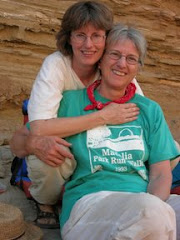
In the social hall after the service, church members were warm, gracious, and generous in the personal experiences they shared with Becky and me and in the number of our books they bought. Then Susie and her husband John Glick (a world-famous potter who made ceramic containers for Diane's ashes) took us home for a fabulous Italian lunch, never once mentioning my rattled performance. John took the above photo of Becky, Susie, and me in their back yard. True friends, pictured here.

Nancy

Wednesday, September 23, 2009

Our Joy of Giving

Yesterday, Becky and I gave 200 copies of Living Consciously, Dying Gracefully: A Journey with Cancer and Beyond to the Breast Cancer Awareness Association (BCAA) of Minnesota, enough so that each participant in the 8th annual Living with Breast Cancer conference can have a copy. (To register for this free October 3, 2009, conference at the Minneapolis Convention Center, click here.) Last year, we also donated copies to BCAA, and responses from recipients indicate that Bill and Diane Manahan’s story benefited them deeply.

Last month, I did something I’ve never done before. Since we were attending the week-long Manahan family reunion in Stowe, Vermont, Becky and I had offered to speak at Hospice Volunteer Services in nearby Middlebury. Bill and Diane’s daughter-in-law Kate Manahan (shown here with Diane), who recently completed hospice volunteer training in Maine, joined us. The hospice Executive Director anticipated 10-15 people would attend, but 30 volunteers and nurses showed up, some of them from hospices an hour away. These women and men were riveted by Diane’s story, crying and laughing right along with the three of us. At the end of our presentation, I said that anyone who bought a book could take a free copy for a hospice, hospital, library, or family of their choice. More books went out the door that afternoon than at any other presentation we’ve given, almost 50 copies.

For the second printing of Living Consciously, Dying Gracefully last year, we ordered 1000 extra copies so that we and Bill would have plenty to give away. We didn’t anticipate how rewarding those gifts would be nor how many cancer conferences, hospices, home-death groups, authors of books about death and dying, public libraries, and random acquaintances we’d connect with. We’ve donated more books than we ever imagined. Diane Manahan, a passionate community activist and philanthropist, would be delighted to see her story reaching so many people, supporting their ability to live more consciously and, when the time come, to die more gracefully.

A few months ago, Becky and I offered a complimentary copy to anyone whose personal end-of-life story is posted on http://www.nanbec.com/. So far, we have received only one story. We thought that the July 2009 New York Times front-page article on home funerals, which mentioned the book (and in the online edition, linked to our website), would spur submissions. Although Amazon.com ranking shot up —Living Consciously, Dying Gracefully became an overnight best-seller in the categories of holistic health, women’s issues, and death and grief—we didn’t receive a single story. The offer is still open. If you have a friend or family good-death story or know someone who does, please contact us: nanbec@nanbec.com.

Similarly, if you know a cancer center, hospice, grief group, or public library that could use a copy of Living Consciously, Dying Gracefully: A Journey with Cancer and Beyond, let us know the address, and we will donate a book in your name. Becky and I appreciate your support for our ongoing joy in sharing our sister-in law Diane Manahan's extraordinary and inspiring story!
Nancy

Monday, July 6, 2009

“Departures,” A Sublime Film

“Departures,” the winner of the 2009 Academy Award for Best Foreign Language Film, is an inspiring glimpse into Japan’s cultural heritage of caring for a body after death.

When a young Tokyo cellist loses his orchestra job, he and his wife move back to his hometown. He answers a classified ad entitled “Departures,” thinking it’s a travel agency only to discover that the job involves washing and casketing bodies. Daigo overcomes his initial revulsion and comes to love the reverential ceremonies, which are transformational for the families involved . . . and eventually for him and his wife.

“Departures” beautifully depicts an approach to death that could teach our culture much. It shows an option between conventional Western funeral practices and caring for our own at home. Although Daigo and his teacher wash and dress the body, they work quietly in the deceased person’s home with the family surrounding their loved one during the entire ritual. There is no embalming. Shocking, funny, and profoundly moving things happen during this process.

Anyone interested in threshold work, spiritual openings, personal transformations, or exquisite filmmaking will enjoy “Departures.” To see a trailer of the film, click http://www.youtube.com/watch?v=TaFRCLAYEF0.

Friday, May 29, 2009

Alison's Gift

When my sister-in-law had terminal-stage breast cancer, she and my brother read a book that changed their lives.

Alison’s Gift is the true story of a seven-year old killed by an air bag in a slow-speed collision. Her mother, Beth Knox, knew that when Alison was disconnected from life-support, she did not want a mortician to take charge. She wanted to bring Alison home, continue caring for her, share her grief, and give Alison’s brothers, grandparents, and friends time to say goodbye.

The hospital said it could not release Alison to her mother’s care. They eventually allowed an undertaker to transport the body home. As Beth learned later, the hospital was wrong; she had the legal right to take Alison home in the van in which she had driven her daughter to school each day.

For the next three days, Alison lay on her own bed. Friends and family members talked and sang to her, prayed and meditated, or just sat quietly, saying goodbye. Several of Alison’s Waldorf School classmates came, and even though some parents were apprehensive about letting them see a body, the children seemed quite comfortable. Spending time with their friend, far from being frightening or creepy, allowed them so experience death as a real and normal part of life.

As a result of this experience, Beth founded Crossings: Caring for Our Own at Death, a national non-profit educational organization. In workshops around the country, she teaches people how to care for a body at home, choose a final resting place, and understand the applicable laws in each state. (For a 3-minute Frontline You Tube story on home funerals featuring Beth Knox, click here.)

Just as the home birth movement has given families more control over birth, the home death movement, which Beth helped found, encourages families to take more control over the other big transition, returning death care to its rightful place as a last sacred family act of love.

My brother and sister-in-law, Bill and Diane Manahan, liked this idea. They ordered a home funeral kit from Crossings. In addition to instructions for after-death care, the kit contained essential oil of lavender for washing the body, a length of white silk cloth to drape over it, and candles. (Although this kit is no longer sold, a Handbook for Home Funeral Care is available for purchase or as a free pdf download at http://www.crossings.com/.)

My spouse Becky Bohan and I were with Diane when she died. I helped bathe and dress her body, hold a vigil, accompany her body to the crematorium, and bring her ashes back home for her life celebration three days later. Becky had a mystical experience at the moment of Diane's death and a joyful visit from Diane several hours later. These profound experiences led us to write Living Consciously, Dying Gracefully: A Journey with Cancer and Beyond, which has won six regional and national book awards and affected readers in ways similar to the impact Alison’s Gift had on our family.
Last month, when Becky and I were in Maryland, we spent an afternoon with Alison's mother. We liked Beth Knox immensely. She is an ideal home funeral educator -- warm, practical, visionary, and passionate about the environment. She told us about the remarkable deaths last year of her mother and her husband’s father, who died peacefully at home, and who requested and received a home funeral.

Following Beth’s lead, our local Minnesota Threshold Network offered a free public information session on home deaths and green, eco-friendly burials in Minneapolis this month. Resources, including Alison’s Gift, were available.

If readers of this blog know of someone who is interested in caring for their own at death, please extend an invitation to read this inspiring book, join the Crossings listserv, and learn from the experiences of Alison and her extraordinary mother.

Nancy


Tuesday, March 24, 2009

Book Buzz!

What's the best thing that can happen to a book?

Buzz!

Many a small title has burst onto the best seller list because of a groundswell of interest. How does that happen? An outstanding book? Inspiration? Perspiration? Luck?

Recently 15 authors from Beaver's Pond Press met at the Edina Public Library to share ideas for generating groundswells of interest in our books.
Several suggestions emerged:

  • Always carry copies of your book with you. Hold one in your hand whenever possible, for example, as you wait to board an airplane. Ask the flight attendant to show it and announce that the author is on board with signed copies. Sales can happen anywhere. And once you're in the air, you don't have to charge sale's tax!
  • Contribute to blogs.
  • Check out on-line resources for Building the Buzz, e.g. Writing-World.com.
  • Contact local newspapers and cable TV to pitch a story idea. They want more than just "local author publishes book." They are looking for an interesting or informative angle to snag readers.
  • Send review copies to the media. Alternatively, you can send sell sheets or postcards asking if they would like a review copy so you don't waste freebies on people who aren't interested.
  • Set up an appealing website and maximize traffic to your site. This is a whole topic in and of itself... especially important for those who are not tech-savvy.
  • Set up readings and presentations at bookstores and libraries. A marketing rep can help you, or you can do it on your own by calling and visiting bookstores that might be interested in your book. Try to get media attention before the event.
  • Think outside the bookstore! Give presentations to organizations connected to your topic. The people who attend are more likely to buy your book.
  • Write articles for magazines (paper or on-line) and get magazines to excerpt parts of your book.
  • Be generous in giving away copies to people who could be good promoters of your book.

Meeting with other authors is a great way to get ideas and support. Once a book is in print, don't put up your feet and wait for readers to discover your title. The ongoing creative work of creating buzz has just begun!!!